
Makowski’s Real Sausage Co. preserves its Polish roots in a new location
Posted: Mar 19, 2026
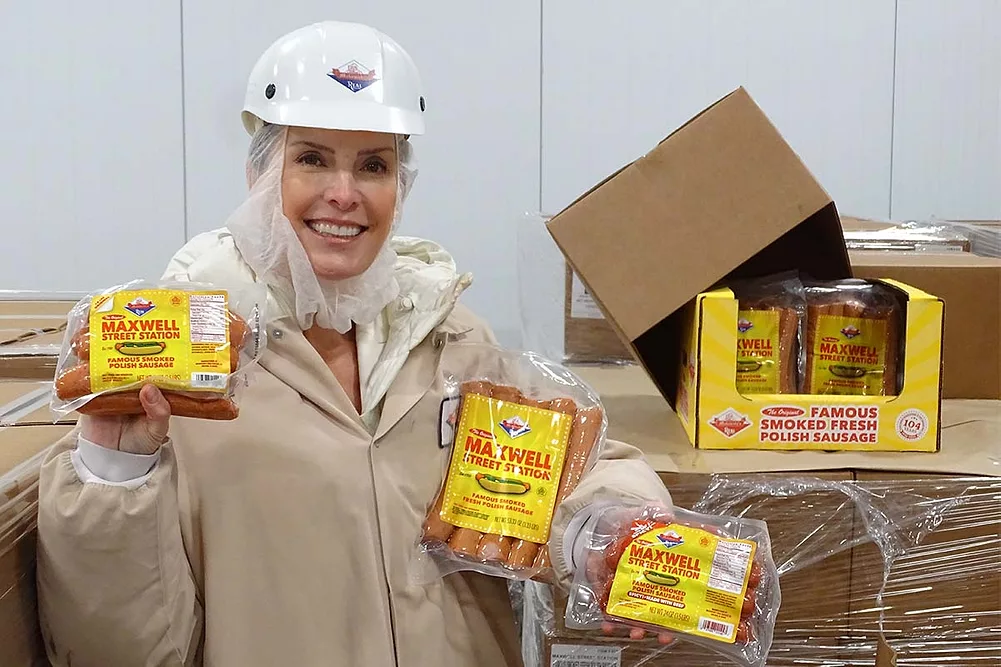
Just a week after moving into her company’s new location in mid-December, Nicole Makowski was feeling like she was at the top of Santa’s list of business owners and got to unwrap an early Christmas gift representing a culmination of generations of her family’s hard work and dedication. Moving Makowski’s Real Sausage Co.’s headquarters and processing plant from its longtime home in Chicago’s South Side to its new location in Lansing, about 30 miles south, was a significant undertaking and a hefty financial investment for the fourth-generation owner, who, at 22 years old, bought the company from her father in 2000.
But it was a decision she doesn’t regret. The tradition and sentimental connection to the company’s three-story building on the fringe of Chicago’s historic Union Stockyards, where it operated for 90 years was strong, but the time had come for Makowski’s to take the next step to accommodate its growth. Business has been booming for Makowski’s with sales increasing by about 30% in each of the past four years. At the age of 48, Makowski is a savvy meat industry veteran. She started working at her family’s 106-year-old sausage company in high school and has owned it for the past 26 years. The company’s reputation for stellar customer service and its consistently high quality of products have led to enviable growth based solely on word of mouth without flashy promotions, advertising campaigns or soliciting new business. Still, production was bursting at the seams at the Chicago plant.
“We just couldn’t make anymore product,” Makowski said. “We were operating 24 hours a day, Looking at that vacated Chicago space now, I don’t even know how we did it,” she said.
But after decades in the location where her great-grandfather moved the company to, the value of that paid-for property increased significantly, and selling it allowed Makowski to reinvest the proceeds in a bigger location with room to grow.
“That’s the only way I could have started this,” she said of the new facilities, which include a 28,000-square-foot processing plant and an adjacently located 10,000-square-foot office space and test kitchen.
Running the processing business from the former plant in a landlocked area of Chicago presented logistical challenges that required relying on an elevator with a 2,000 lb capacity to move product and supplies from one floor to another. Makowski does not miss that part of the old plant in the least.
“I was absolutely not going back to using an elevator; I hate elevators,” she joked, explaining how her wish list for the new location included a single story building and more space, preferably in the proximity of the South Side in a community where the sights, sounds and aromas of a meat processing operation would be accepted.
The company’s new location is comprised of two buildings, including an office space alongside a dedicated processing plant just across the parking lot. The office space was converted from what was formerly an automobile bearing shop that had been vacant for years. It now is home to Makowski’s shared office space, Nicole’s office, a dry storage area and a test kitchen. The building next door was converted from a dated two-story furniture storage building to what is today a one-story sausage plant.
The goal was to create a processing flow that was circular to maximize efficiency versus the vertical flow of the old building, where two people were needed to operate the cumbersome elevator every day. Another goal was to design the facility with designated, separate sanitation corridors for ready-to-eat processing and raw processing to ensure the food safety of Makowski’s products.
Location matters
Shopping for the right location for the company took some time, patience and plenty of vision for what could be. A big part of the search included identifying a municipality that was willing to add a meat processing operation to their community.
“You don’t build something of this magnitude and not have a town that’s willing to work with you,” Makowski said, adding that Lansing’s economic development plans include drawing more manufacturing companies like hers.
The vision for a new location never included buying two separate buildings, but the structure next to the former bearing shop that is now the office, was abandoned and in tax foreclosure, so the city was happy to make Makowski a deal she couldn’t refuse on both properties, including some generous tax-incentive financing.
The search began in early 2024 and the purchase of the properties took place about a year later and construction began almost immediately to transform the buildings, with a planned finish date of about eight months.
“I’ve never done anything like this,” she said of the extensive renovation project that totaled $10 million for both buildings. “I did a lot of construction in Chicago, but nothing of this magnitude. The only thing we kept were the four walls in both buildings. Everything is literally 100% brand new, all new mechanical, roof, HVAC, refrigeration.
“I initially had no interest in this building,” Makowski said of the office space, at least not until she started sketching out the layout of the processing floor and realized there would not be enough room left to accommodate the offices, test kitchen and storage areas in that single building, which was two stories prior to the renovation.
“I didn’t want an elevator, and we needed height for a racking system,” Makowski said, which meant transforming the 1970’s era facility to a single story, dedicated sausage plant. She soon realized purchasing the building next door was needed to have space for non-processing parts of the business.
The renovation process was extensive and included tearing out and replacing all the concrete and tuck pointing, installing new incoming water lines, and re-paving the driveway.
Learning curve
“I’ve definitely learned a ton from this whole project, and not things that you would learn in a normal course of running a business,” Makowski said of the experience. “But I would totally do it again.”
Part of the move included transporting a Reiser linker and an older 23-year-old Handtmann stuffer as well as a Tulsa chopper from the former plant, which meant cutting a hole in the second-floor wall of the building and craning the equipment out.
The new plant affords the company much more space and it is equipped to double Makowski’s volume, including smokehouses that are twice as big as those at the former plant, each capable of holding eight racks of products. Another significant investment was the addition of a much larger chill cooler where cooked products reside until they are ready for packing. And a freezer that quadrupled the size of its cold storage.
For now, the plan is to continue the familiar cadence of processing and cooking products each morning and cooling them overnight to be ready for packing the next day, but she foresees the need to cook and pack in the same day as the business grows.
With the move to the new location, Makowski’s was able to retain about 80% of its production workers and plans to fill those vacated positions with applicants from the Lansing area. Those that made the move were pleasantly shocked to see the new, bigger space, including the state-of-the-art technology in the plant, the flow of the process in a single-story configuration and the employee amenities, including a designated break room and locker rooms. Currently, Makowski’s employs 40 people, and she anticipates adding up to 20 more positions as the plant’s production increases and both lines in each of the two departments (ready to eat [RTE] and raw) are up and running at full capacity.
With the new production flow and more efficient processes, Makowski said workers also appreciate the stability of a set schedule, starting at 6 a.m., five days a week, compared to what was a more unpredictable production schedule at the former plant, which also resulted in an abundance of overtime due to the older facility’s operational inefficiencies. The new, streamlined plant is exponentially more efficient, Makowski said. For example, a preliminary test run at the new plant to produce and cook 12,000 lbs of products in December, just after move-in, was completed in about nine hours, which would have required 24 hours at the former facility. And the cadence of producing only a week’s worth of production at a time will soon be ramped up.
“We are changing that,” Makowski said with a big smile in anticipation of new storage racks being delivered and installed in the new plant’s freezer, which is about four times the size of the Chicago plant. “I can’t wait,” she said, looking forward to the day when the plant is able to process long runs of one SKU and maintain a month’s worth of inventory of all products on a regular basis once sales warrant that level of inventory.
“We’re going to fill those houses; we’re going to run efficiently and that gives us better yields. I’m looking forward to that for sure.”
The new facility allowed Makowski’s to expand to three stuffing lines on the raw production side of the plant, compared to two at the former plant, and three RTE packing lines with a product mix that includes well over 100 different products. Currently, sales are divided evenly between Makowski’s Real branded products and co-packed products, including halal products for four different customers as well as private label customers for distributors and other manufacturers.
New reality
The company’s recent growth means it no longer can accommodate small batch requests for new customers wanting just 200 lbs of product, for example.
“I’m saying ‘no’ sometimes now, where maybe back in 2018 I was saying ‘yes,’ because now we have higher minimum orders, I just can’t do that,” she said of the small batches, unless the request is from a longtime customer. With three new, Alkar smokehouses with twice the capacity of the previous plant’s, it doesn’t make good business sense to use a fraction of the capacity for a one-off small batch.
Today, the company’s retail business comprises between 20% and 25% of its sales, with the biggest name customer being Costco stores, where it supplies all the products for the warehouse chain stores in the Midwest during the summertime sausage season and 20 locations during the off season. As the company continues growing, Makowski said wearing so many hats, including serving as the company’s only salesperson, may have to change someday soon to include a designated salesperson to grow the retail business.
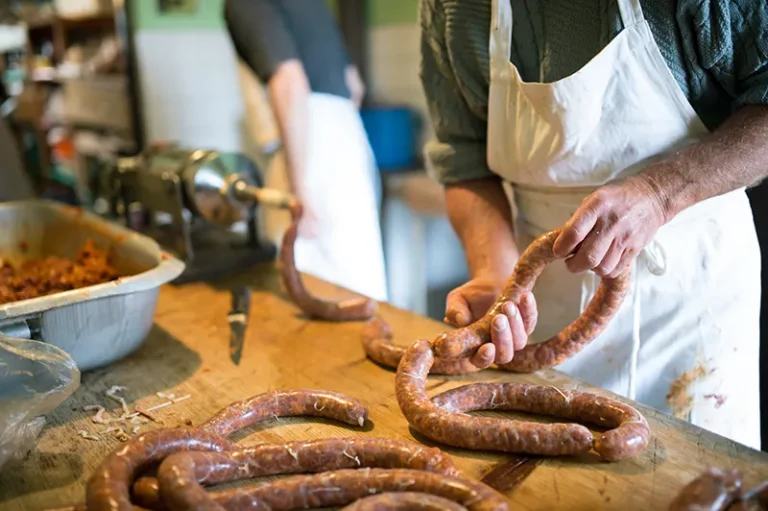
More than 90% of all Makowski’s products are cooked/RTE and the small amount of raw is for foodservice (all of the retail products are cooked). Retail products include its Maxwell Street Polish sausage in 12-oz, 24-oz and 5-lb packages; Andouille Sausage (24 oz), All Beef Maxwell Street Polish (5 lb) and All Beef Spicy Maxwell Polish (1.5 lb). For foodservice customers, skinless and natural casing beef and pork smoked sausages are available in a variety of package sizes, with natural casing Maxwell Smoked Pork and Beef Polish varieties available in 7-inch, 9-inch and 11-inch links. Franks for foodservice customers are also available in a wide variety of package sizes and types, including skinless beef, skinless all meat and hog casing wieners made from pork and beef. Italian Sausage is also available in a variety of sizes as well as bratwursts.
Besides Costco, Makowski’s partners with about two dozen distributors. Makowski’s signature Maxwell Street Polish sausage branded products are also sold in smaller independent retail operations in the Chicagoland area, including Pete’s Fresh Market, Cermak Produce Fresh Market, Peoria Packing and Park Packing. The Maxwell Street Polish is also a mainstay on the menu of Portillo’s Hot Dogs, the iconic fast-casual restaurant chain of 90-plus eateries known for Chicago-style hot dogs and Italian beef in several states. Makowski’s hot dogs have also become a mainstay at Home Depot stores in the Chicago area, where they are served from a chain of Fixin’ Franks stands inside select home improvement locations.
Polish flare
But when it comes to the tradition and DNA of Makowski’s Real Sausage Co., there is only one product that defines it.
“We are Polish sausage people, and we have taken over the Polish sausage world,” Makowski said, estimating that product accounts for about 25% of the company’s total sales. With plenty of awards to back up her claim, including being voted Best Maxwell Street Polish this past year, she proudly proclaimed, “Polish — that’s what I’m known for by sausage people.”
In the past six to eight years Makowski said her business approach has evolved, and she has recognized the benefit of focusing on what is working best and accentuating that in the new location.
“I want to stay in my lane and be successful, not that I wasn’t before, but you want to be really good at what you’re doing,” she said, and for Makowski’s that is a three-pronged strategy. “Number one, you’re putting out a good product. Number two, you’re getting a reputation that you know what you’re doing is really good. And three, it streamlines and works within the business.”
That mindset helps dictate the feasibility of growth areas, such as a request to produce raw, fresh product for the retail market which is a non-starter for now.
“I’m not sure about it. We would need to purchase several pieces of equipment. Just in case I change my mind, we added the necessary features for expansion,” she said.
To facilitate that switch, she had the office building equipped with the infrastructure to accommodate the transition.
“So, all the electric, the water, everything is here if we ever get to that point,” she said.
And Makowski doesn’t assume quality and customer service will take care of itself.
“I know that if the quality, customer service and product consistency is not top notch, our customers will look elsewhere. We want to make sure our customers have nothing to worry about. Consistency is key.”
Source: Crews, J. (2026, February 23). Makowski’s Real Sausage Co. preserves its Polish roots in a new location. Meat & Poultry. https://www.meatpoultry.com/articles/33153-makowskis-real-sausage-co-preserves-its-polish-roots-in-a-new-location